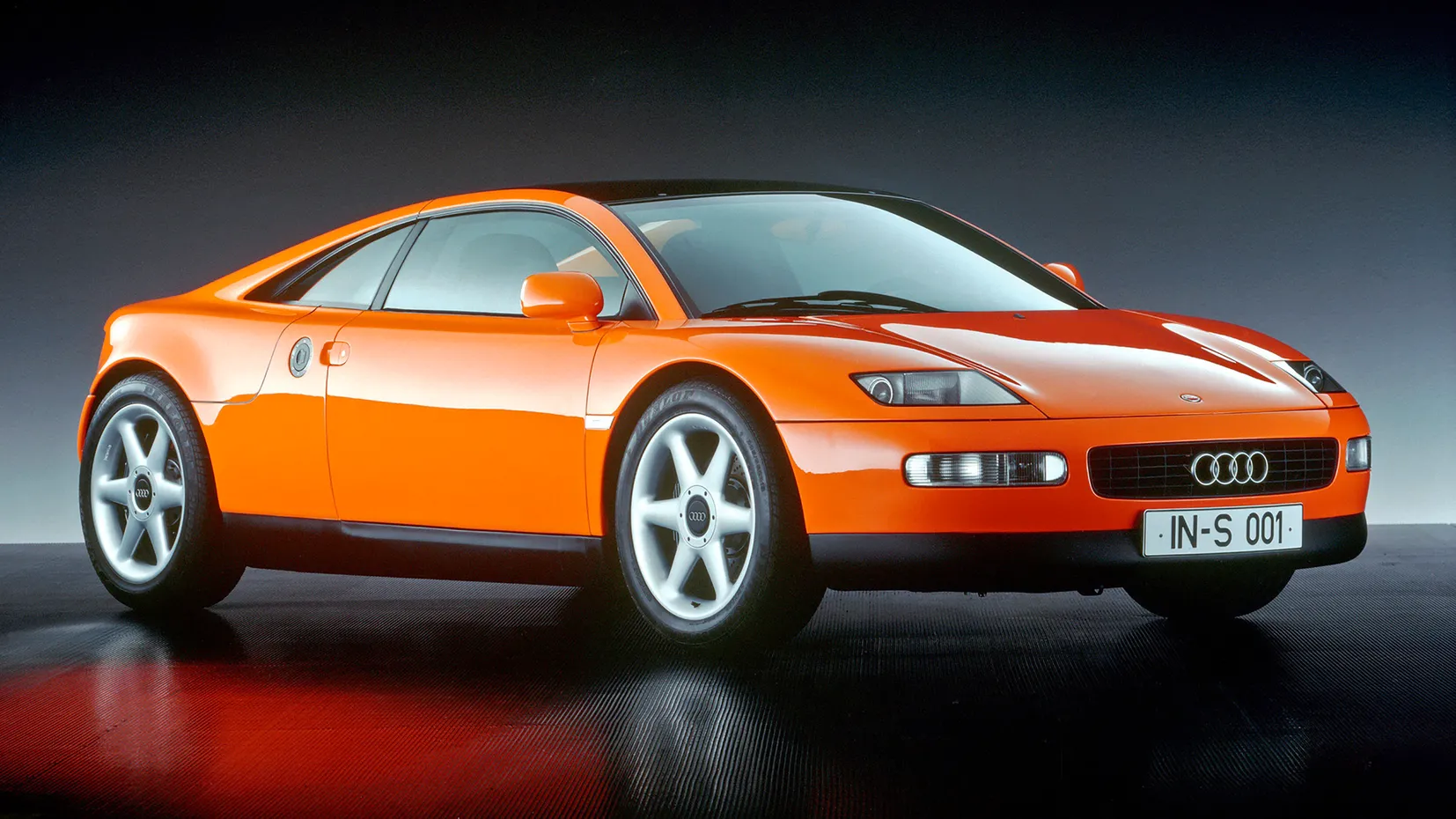
In September 1991, at the Frankfurt Motor Show, Audi unveiled the quattro Spyder concept. Developed under the leadership of CEO Ferdinand Piëch and chief designer Hartmut Warkuß, it was meant to show what a new Audi sports car with quattro all-wheel drive could look like after the legendary original. The car was even considered for small-scale production: dealer brochures were prepared, and pre-orders were reportedly collected.
By 1992, however, the project was abruptly canceled. The reason was the high production cost of its aluminum body combined with the early-’90s economic downturn. As a result, the quattro Spyder remained a prototype, though it became the starting point for Audi’s aluminum technology (ASF), which later appeared in the Audi A8 (1994). The idea of a mid-engine quattro sports car also survived, eventually materializing in the R8.
Thus, the quattro Spyder was not a direct successor to the original quattro, but rather a bridge — a symbol of transition from the 1980s rally legend to Audi’s modern sports car identity.
Read too:
Lamborghini Cala history: a prototype in the shadow of the Gallardo

Audi quattro Spyder (1991) specifications

1.Power: around 174 hp

2.Acceleration: 0–100 km/h in ≈ 6.0 sec

3.Top speed: about 250 km/h

4.Engine: V6, 2.8 L, mid-mounted

5.Range: approx. 450–500 km (with standard fuel tank and average consumption of 10–12 L/100 km)

6.Dimensions: length 4,180 mm, width 1,770 mm, height 1,170 mm, wheelbase 2,560 mm

7.Technology: quattro all-wheel drive, aluminum body (ASF – Audi Space Frame), disc brakes all around

8.Additional features: removable targa-style roof, lightweight construction (≈ 1,100 kg), driver-focused interior

Intresting Facts About Audi Quattro spyder:
Debut:
The Audi quattro Spyder was unveiled at the Frankfurt Motor Show in autumn 1991 as a two-seater mid-engine coupe with quattro all-wheel drive.
Positioning:
The concept was intended as a “mass” Audi sports car, priced around 60,000 DM with a limited production run.
Construction:
The body featured thin aluminum panels on a lightweight steel frame, with the car weighing about 1,100 kg.
Innovations:
Double wishbones, ABS, a transparent roof with two removable glass panels, and a unique dashboard were all advanced features for the early 1990s.
Cancellation:
The project was canceled in 1992 due to the recession and competition from the Porsche 911, despite receiving around 3,000 pre-orders.
Legacy:
Many of the Spyder’s technologies and design elements influenced the Audi A8, TT, and R8, especially aluminum bodies, mid-engine layout, and two-seater configuration.
Impact:
The quattro Spyder remains little-known but influential, shaping the image of future Audi sports cars.
Read too:
New Audi A2 2025: The return of a legend in a modern form

Conclusion:
The Audi quattro Spyder was a bold experiment that combined innovative technology, lightweight construction, and striking design. Although it never reached production, its ideas left a lasting mark on Audi’s future sports cars, influencing models like the A8, TT, and R8. The Spyder remains a rare and visionary concept, demonstrating Audi’s commitment to pushing engineering and design boundaries in the early 1990s.
Future Classics: 8/10
Brand Recognition: 7/10
Design Modernity: 7/10
CarsCorn Score: 7.3/10