
Nissan Stagea is the same case when Japanese engineers decided to cross the practicality of a family suitcase with the fury of a road monster. It all started in 1996, when the world saw the WC34 body. From the outside, it was a long, somewhat awkward station wagon, but under its “civilian” clothes the insides of the legendary Skyline were hidden. This is what made the Stagea cult: you could take your mother-in-law to the dacha in the morning, and in the evening embarrass the owner of a Ferrari at a traffic light.
The most madness happened when the Autech studio took up the matter. They created the 260RS version, simply transplanting the “heart” from the Skyline GT-R R33 into a station wagon. The legendary RB26DETT engine, all-wheel drive and manual transmission turned the Stagea into a real rocket, which fans still call “GT-R in a station wagon”. And thanks to the perfect compatibility of parts, owners began to attach the “muzzle” from the Skyline R34 to the Stagea en masse, creating the same famous hybrids that became icons of JDM culture.
Later, in 2001, the second generation appeared – the M35. It became more solid, received a platform from the Nissan 350Z and VQ series V6 engines. It was no longer so much a daring hooligan as a fast business jet for the roads. However, the turbocharged versions still produced an honest 280 horsepower, maintaining the model’s status as one of the fastest station wagons of its time. And although the Stagea story ended in 2007, it was forever remembered as a car that proved: family life is not a reason to give up adrenaline.
Read too:
New Nissan Patrol 2026: Brutality in simplicity

Nissan Stagea 260RS Autech (Series 2) Specifications:

1. Power: 280 hp (officially rated due to the Japanese "Gentlemen's Agreement," though actual output was closer to 300+ hp) @ 6,800 rpm. Torque: 368 Nm.

2. Acceleration: 0–100 km/h: Approximately 5.7–6.0 seconds.

3. Top Speed: Electronically limited to 180 km/h (Unlimited: 250+ km/h).

4. Engine: 2.6L RB26DETT inline-six, cast-iron block, twin-turbocharged, 24-valve DOHC. All-wheel drive (ATTESA E-TS), 5-speed manual transmission (FS5R30A).

5. Range: Approximately 400–550 km, thanks to a 68-liter fuel tank and an average fuel consumption of 13–16L/100km (significantly higher under spirited driving).

6. Dimensions:
Length: 4800 mm
Width: 1755 mm
Height: 1495 mm
Wheelbase: 2720 mm
Weight: ~1720 kg

7. Technology: Brembo braking system (4-piston front/2-piston rear), multi-link independent suspension with front and rear stabilizer bars, electronic torque-split AWD system, and a mechanical Limited Slip Differential (LSD).

8. Additional Features: Exclusive body kit by Autech, signature rear spoiler, 17-inch BBS forged wheels as standard, GT-R style interior with bolstered sport seats, triple-gauge cluster (volts, oil pressure, boost), and an immense cargo area that combines supercar performance with family-wagon practicality.
New 2026 Nissan GTR Wagon:
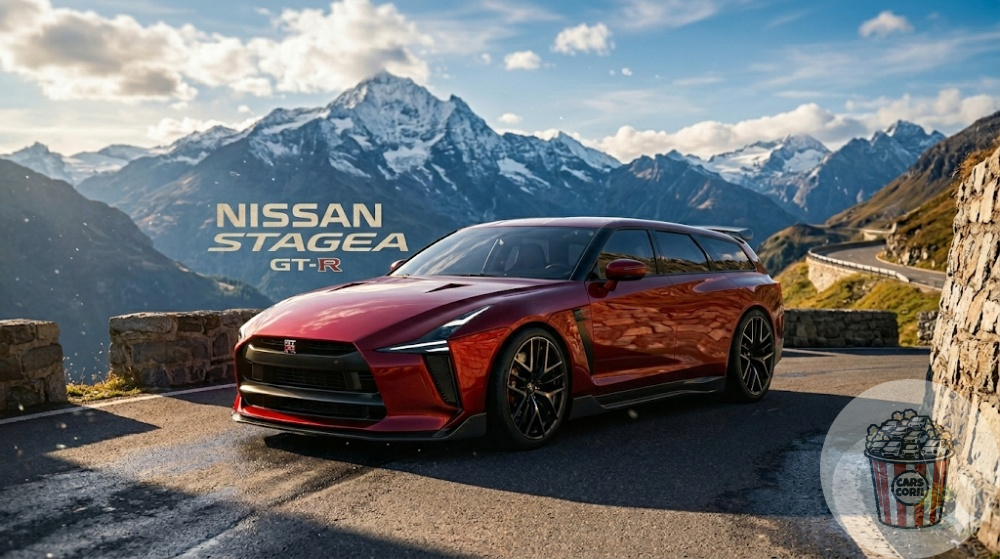
Nissan once had such a car, but the model did not gain popularity. Now we do not know the appearance or even the fate of the new Nissan GT-R. However, this gives room for imagination, and the Wagon body is one of the interesting variations.
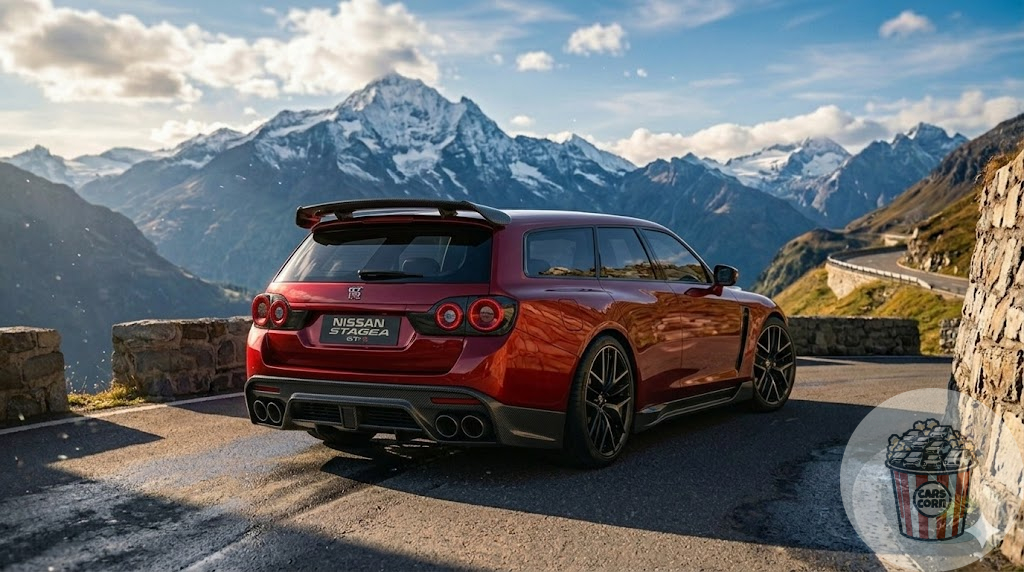
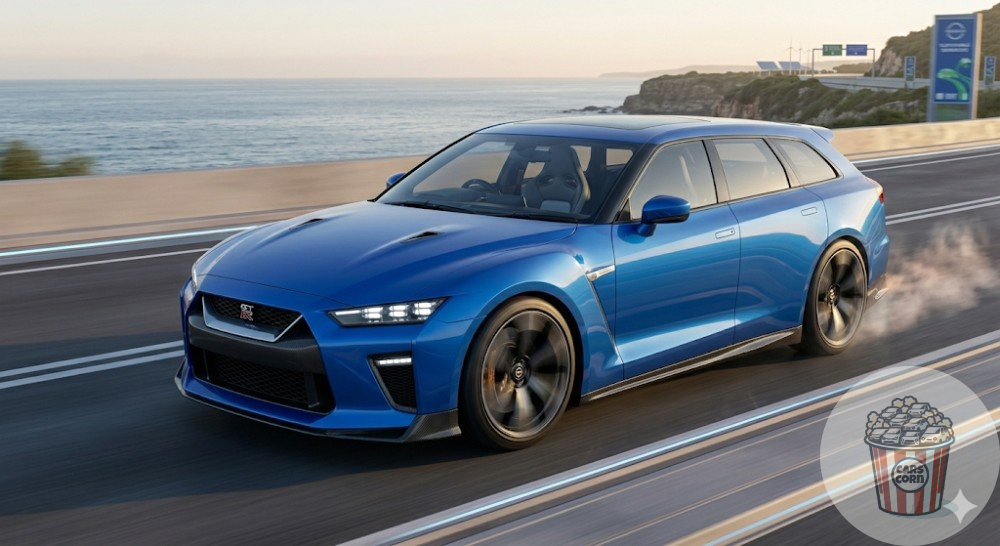
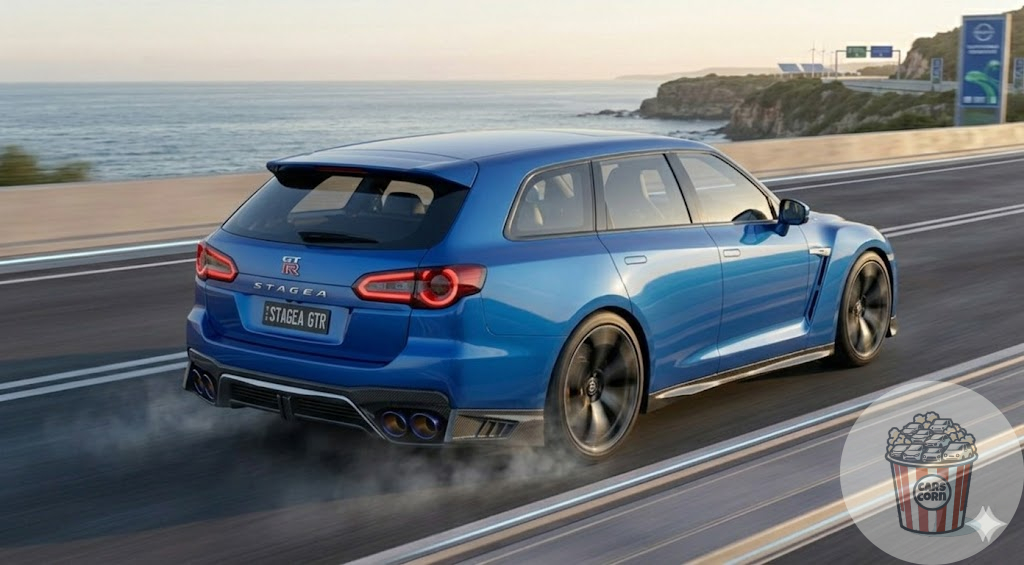
The first photo demonstrates the unique combination of the design of the Nissan R36 concept. It looks successful, balancing between modernity and the trademark brutality of “Godzilla”. In contrast, the third image offers a completely new design. The authors were inspired by the R35 and R34 models, which creates a conceptually correct image. The rear part looks original. Upon closer inspection, the influence of the classic Nissan GT-R with its aggressive style is noticeable.
Read too:
New Jaguar XJR-15 2026: classic with a modern twist
Future Classics: 7/10
Brand Recognition: 8/10
Design Modernity: 8/10
CarsCorn Score: 7.7/10
That’s a really interesting thought. The Stagea definitely shows how far Japanese auto companies were willing to push the boundaries of performance and cargo space.
Stagea was truly unique, I wonder why they don’t make them like this now?